This a primarily a blog about wristwatches but from time to time I will speak out on issues of concern when I feel I have something to add to the conversation.
I’m not an infectious diseases or public health specialist, so as always, check with federal, state, and local authorities in your area. The CDC website is here.
However, I am a physician who has followed the pandemic closely and I would like to provide this update in order to help inform my readers and combat misinformation.
What is Omicron?
Omicron has been labelled a “variant of concern.” All viruses accumulate mutations randomly as they replicate, creating variants. The more replication, the more mutations. Since COVID-19 is a global pandemic, the SARS-CoV-2 virus has many opportunities to replicate itself. (SARS-CoV-2 is the virus, COVID-19 is the disease). Mutations are random and most have no effect or may make the virus less efficient and those variants peter out. Variants of concern are those viruses which carry a set of mutations which either make them:
- Spread more easily
- Thwart public health measures, especially vaccination, or
- Are more deadly.
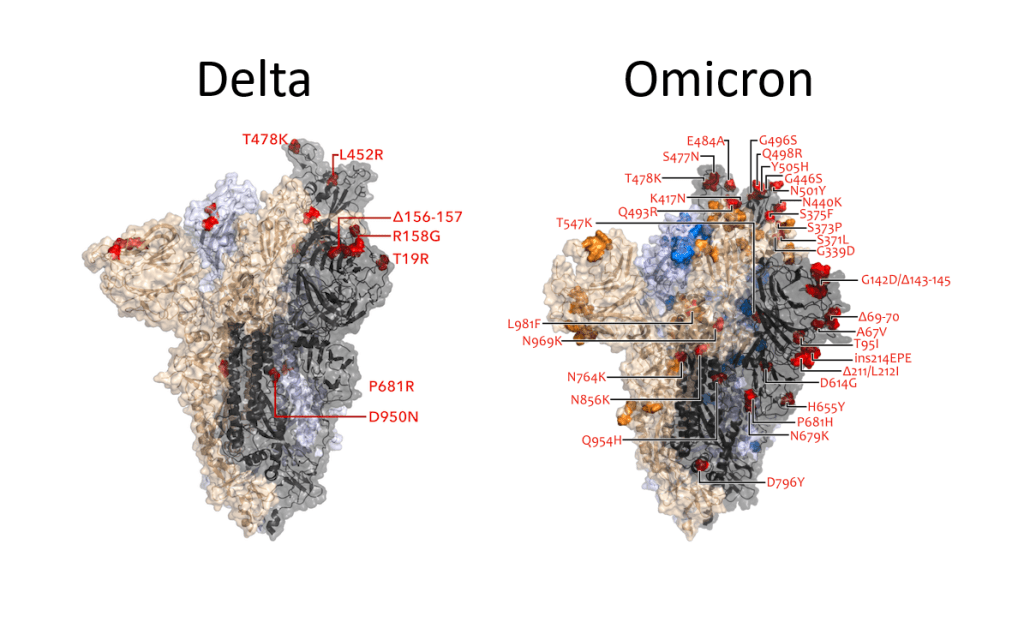
Omicron carries a large set of mutations including those in the spike protein (S glycoprotein), which is how the virus attaches itself to and enters a cell. Currently most of the world is dealing with a surge in the Delta variant, which is significantly more contagious than the original SARS-CoV-2 virus (1), has some reduction of vaccine efficiency against infections but vaccines remain generally effective against serious disease (2), and also seems to cause more serious disease, especially in the unvaccinated (3). As bad as it is, in a way Delta has had a good effect for the vaccinated. Since it is much more contagious, it has outcompeted variants such as Beta which have more vaccine resistance (2). In other words, variants like Beta have not been able to establish a foothold in the United States because the available hosts (mostly the unvaccinated) have largely been infected with Delta instead.
Why Are We Worried About Omicron?
Omicron is a problem because it has outcompeted Delta in South Africa and caused a surge in COVID-19 cases more severe than the Delta surge. In order to take over from Delta, the virus must have some evolutionary advantage. In other words, it spreads more easily. Based on the data so far, this is because it is:
- More contagious
- More able to infect hosts with resistance from prior infection or vaccination
Vaccines 1: How Do Vaccines Work?
The key question for now is whether vaccines are still effective against Omicron. All three vaccines approved in the United States (Pfizer, Moderna, Johnson and Johnson) are targeted against the spike protein which carries 37 mutations in the Omicron variant.
Vaccines work in two ways. They stimulate the immune system to produce antibodies that neutralize a virus and also provoke a complex response which is referred to as T cell mediated immunity. Antibodies levels can be measured and are stimulated by booster shots. T cell mediated immunity is longer term and more adaptable to different, similar viruses but we cannot measure it directly at the current time.
Vaccines 2: What We Know From Antibody Neutralization Assays
We can measure the antibody response by taking serum from patients who have had the vaccine and mixing it with the variant virus or a dummy virus carrying the same spike protein in a lab to see if the virus gets neutralized. So far with Omicron, the results have shown that a 2 doses regimen of Pfizer and Moderna work much less well in lab studies than they did against the original virus. We have also seen that other vaccines such as Johnson and Johnson and AstraZeneca do not work very well or at all in terms of neutralizing antibodies. A key issue in South Africa, which has a low level of vaccination but had a high level of prior COVID-19 infections, is that a prior COVID-19 infection does not offer much protection against reinfection with Omicron.
The good news is that it seems that a booster shot works very well against Omicron so generally speaking we expect that people who have had booster shots have similar protection against Omicron as the vaccinated had against original SARS-CoV-2.
Jury Still Out: Unanswered Questions about T cell immunity
However, it is critical to recognize that T cell mediated immunity is also a factor, and we have no way to test it other than to wait and see what happens to people who had vaccines but not a booster. The hope is that T cell immunity will offer some protection against severe disease for those who are vaccinated but not boosted, or who had a prior infection. However, this is far from assured.
Jury Still Out: Does Omicron cause less severe disease?
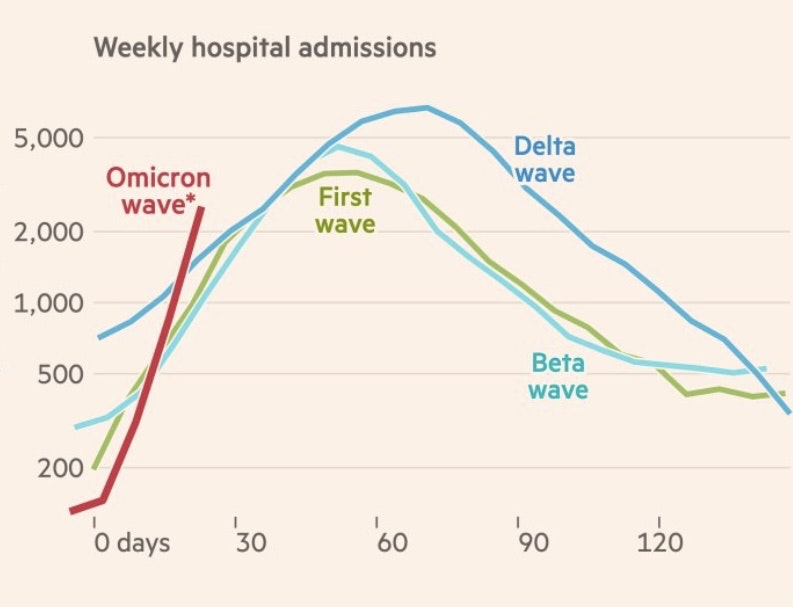
The Omicron wave in South Africa seems to be associated with fewer hospitalizations and less oxygen use than was seen at a similar point in previous waves of infection. Some have speculated that Omicron may be an intrinsically less virulent variant, that is to say, it causes less severe disease. There are a number of confounding variables however, among them that there is not enough information and that the population in South Africa is younger and healthier than the population of the United States.
The Importance of Protecting Others
Keep in mind also that Omicron, being more contagious than Delta and more likely to infect hosts with some prior immunity, is likely to stress and could possibly overwhelm health care systems. Even if the death rate is half that of Delta (unlikely), if it infects twice as many people, just as many will die. If the health care system becomes overwhelmed, that means that patients who are having other medical emergencies such as a car accident, heart attack, or stroke will not be able to get care in a timely fashion. Surgeries for serious conditions such as cancer may be postponed due to lack of available beds on the hospital floors or intensive care units.
There are also many immunocompromised people in our society who cannot generate a good immune response even with full vaccination and boosters, who are at high risk in an Omicron wave. Additionally, children under 5 have not yet been authorized by the FDA to receive a vaccine, although it is anticipated that this will change in 2022.
Your individual choices of whether to get vaccinated, whether to get a booster, and whether to stay home and get tested for COVID-19 when sick, will help to determine what happens over the next few months.
Take Home Lessons
There is a lot we don’t know about Omicron yet. In the United States, we are in the midst of a surge in Delta cases brought on by people gathering indoors because of cold weather and holidays. Hospitalizations are rising, largely due to severe illness in the unvaccinated.
My take home lesson from the data on Omicron so far is if you haven’t been vaccinated, even if you had a prior infection, you need to get vaccinated immediately. This variant is highly contagious and is likely to rip through the unvaccinated at an alarming rate. If you have been vaccinated, you should seek out a booster if you have not received one already.
As always, common sense measures such as indoor masking in crowded spaces and staying home and getting tested when sick can help prevent the spread of any SARS-CoV-2 variant. Remember, a mask protects not only you, but those around you.
On a personal note, as the parent of a toddler who is too young to receive the vaccine, I implore you to get vaccinated if you haven’t already and to get a booster if you have not yet gotten one.
We still have a long way to go but the only way to get there is together.
 The Lost Spring Bar