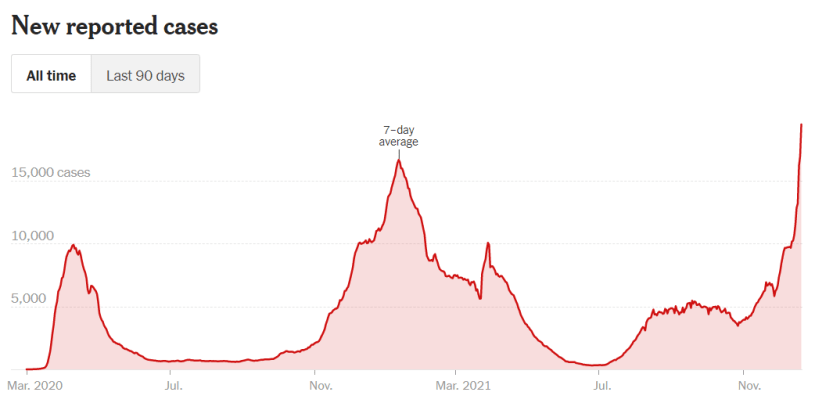
It has been about 3 weeks since the first Omicron case was found here in New York State. The rise in cases has been explosive. Our DAILY average number of new cases is over 20,000, whereas it was hovering around 5,000 during the Delta surge and had dipped to around 3,500 prior to Omicron’s likely introduction in the beginning of November.
As I’ve discussed before, the combination of receiving a booster shot and wearing a high filtration mask indoors is the best way to try to avoid contracting Omicron. If you have not gotten a booster shot, you are really behind right now because it does take at least 2 weeks for the full protection to kick in.
One thing we have learned about COVID-19 is that it gets out of control before people realize what is going on. By the time you read about it in the papers, it is already here. Remember, it was only on November 25th that Omicron was discovered in South Africa but there was already the beginning of a surge here in New York from the beginning of November. As it did last year, Thanksgiving travel and indoor gatherings likely turbocharged the spread.
I think there is a lot of denial when it comes to the Omicron variant. The ban of travel from Southern Africa was wishful thinking, as by the time Omicron was discovered it was already probably widely seeded with community spread in the United States. The most troubling area of denial is the assertion that Omicron causes milder disease. The scientific basis for this idea is that the hospitalization rate in South Africa did not keep up with the rate of spread, and that Omicron grows 10X slower in the lung parenchyma (lung tissue where oxygen exchange occurs) but 70X faster in the bronchi (the tubes that carry air to the lung tissue). The faster replication in the bronchi is thought to lead to more virus being breathed out as an aerosol (i.e. floating through the air to infect others). The New York Times had a great graphical presentation that showed a supercomputer modeling of SARS-CoV-2 viruses traveling in a aerosol. Delta had a much more positively charged spike protein on its outside, leading to mucin in the aerosol particle to encapsulate it and protect it as it floats through the air relative to the original virus. The Omicron strain had an even more positive charge, so it probably is more efficient at traveling through the air and lingering around for other hosts to breath in and get infected.
The idea that Omicron is more transmissible yet causes less severe disease led to the thought that Omicron will sweep through the population and create herd immunity. There are a few problems with this idea. Probably the biggest issue is the assumption that Omicron is not going to evolve further as it spread rapidly here in the US and potentially become more virulent.
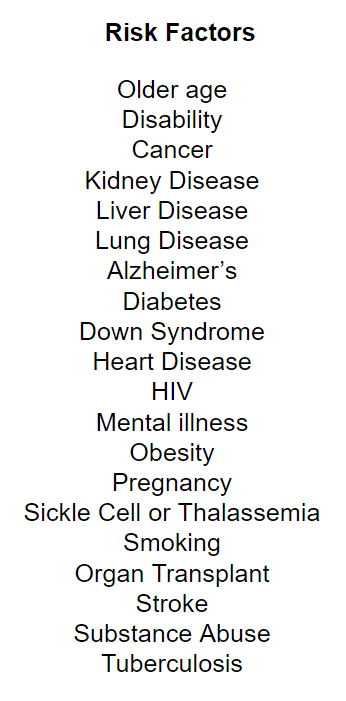
The South Africa data regarding hospitalizations is probably not very applicable to the American population. We generally think that the severity of Omicron infection will be inversely proportionate to the amount of immunity and proportionate to the host’s risk factors. Certainly the risk profile for the US population is worse because the South African population is younger and heathier.
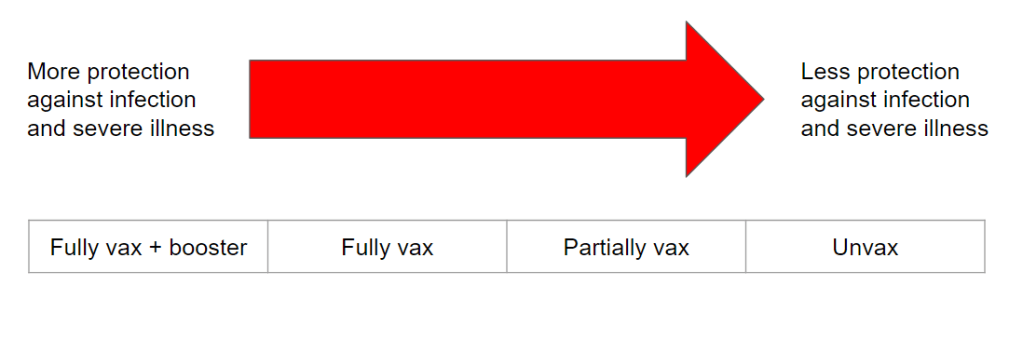
The amount of immunity, and how protective various levels of immunity are against severe illness, is the million dollar question. The South African population has about a 25% vaccination rate but an 80-90% estimated prior infection rate. The US has a 60% vaccination rate with about 17% boosted. I haven’t seen a good estimate of what proportion of the US population has had a prior infection. One of the problems in the US is that some areas are much less well vaccinated than others. The heterogenous distribution of vaccination amongst the US population means that there are many areas of “dry tinder” for the fire of Omicron to smolder and spread even when it dies out in others.
Without having a comparable population, it is really impossible to know how Omicron will behave here. The general thought now is that the boosted will have weakened but very good protection against infection as well as severe illness, the fully vaccinated will be poorly protected (around 30%) against infection but have some resistance to severe illness, and the partially vaccinated will be worse off, and the unvaccinated will be the worst. The amount of protection is very uncertain right now and is influenced by the risk factors that are prevalent in the population, such as obesity, diabetes, and so on.
Based on the very early hospital reports, my impression is that hospitalizations are rising sharply in a very alarming fashion. I think there is a very likely chance that hospitals will again be overwhelmed, as they were in the beginning of the pandemic. Remember that hospitals being overwhelmed means that if you get in a car accident and are injured, if you have a heart attack or a stroke, if you develop appendicitis, or any other serious health problem you may not be able to see a doctor in the emergency room fast enough to save your life because there is no space. It also means that surgeries for serious illnesses such as cancer may need to be postponed because there is no ventilator to go on during anesthesia and no ICU bed to go into for monitoring afterwards. Besides being burnt out, some proportion of hospital staff is likely to have breakthrough infections which means that understaffing will exacerbate the problem while they isolate. In retrospect, vaccine mandates for hospitals was a VERY good idea as it increased the vaccination rate dramatically. Unfortunately there has not been time to institute a booster mandate.
In March 2020 we managed to “flatten the curve” with consistent public exhortations by former Governor Cuomo which also mentally prepared the public for drastic, severe, widespread lockdowns. I don’t think there is an appetite for those types of lockdowns now and frankly, it is a day late and a dollar short when it comes to administering boosters and increasing the amount of testing. Omicron is increasing exponentially and there really isn’t anything left to do but lock down. Unfortunately we probably won’t get there until it is too late.
My only hope at this point is that even without government mandates, I do see people acting responsibly in my neighborhood, wearing masks and avoiding indoor gatherings. People around here know what to do to stop the spread and flatten the curve. It’s been built into our mindsets at this point in the pandemic. I think there is a small possibility that many individual acts of responsible behavior may yet flatten the curve but we will know within a week or two.
 The Lost Spring Bar