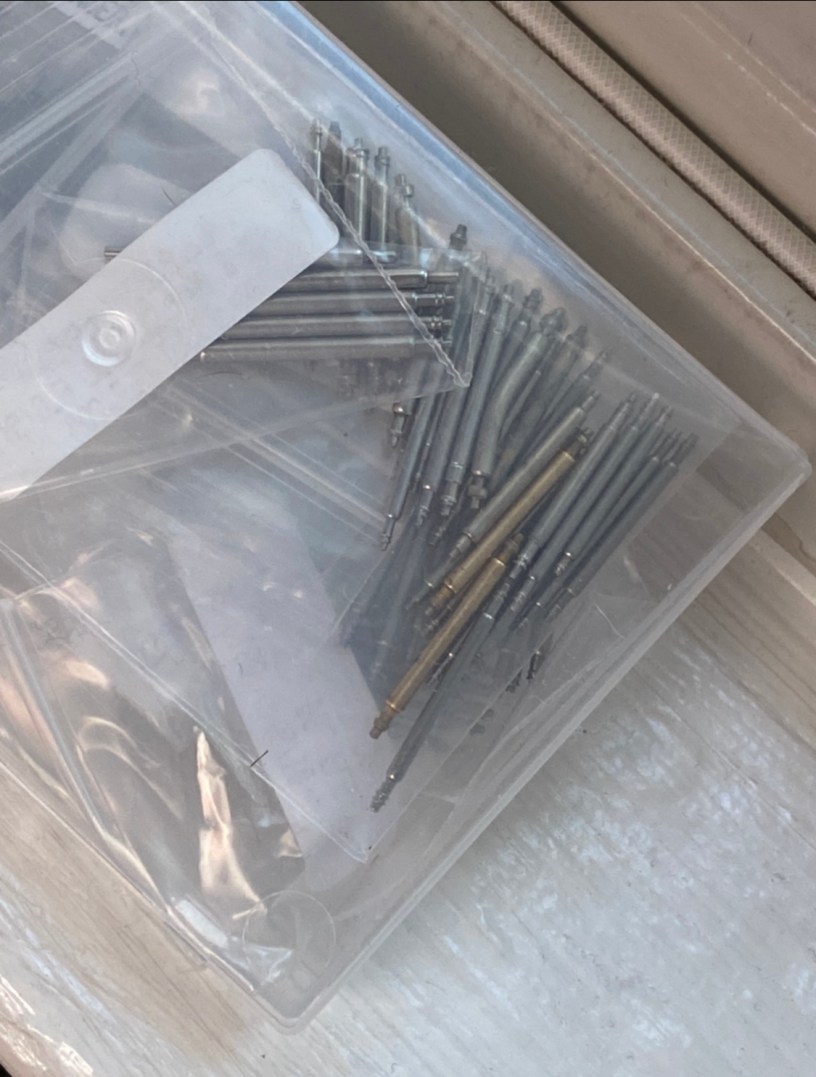
Now that Jack Forster has left Hodinkee, there is a dearth of spring bar related content. Therefore, allow me to present my guide to finding a lost spring bar. First, my qualifications. I am a vascular surgeon, which means that I use tiny needles to fix arteries in the operating room. If the surgery is long and complex, there many be a dozen or more tiny curved needles about 10 mm long and tapering down to a point from 0.5 mm thick. The scrub technician keeps track of them but once in a while, especially in an emergency, a needle may get lost. This results in an incorrect needle count at the end of the surgery. Usually everyone looks for it because unless it is found, an x-ray needs to be taken to make sure it is not in the body. So maybe a couple of times a year, I may find myself looking around for a tiny needle, much smaller than a spring bar, somewhere in the operating room, and I ALWAYS find it.
Step 1: Do you really need it?
Seriously. Think about it. There’s plenty of spring bars in the world, do you really need this one? I have a toddler at home and a not-too-smart dog so I need to find mine for safety reasons. Another justifications for a long and arduous search would be if you have a vintage watch with an odd spring bar, such as one with male lugs where the lugs jut out and the spring bars have a hole in them, or a gold spring bar if you are a fancy collector. I try to keep a few basic sizes in stock but once in a while I forget that I am low on 17 mm extra thin spring bars and that is an extra impetus to find the one that went flying a minute ago.
Step 2: Assess the environment
Are you on a carpet or a wood floor? Carpet has the advantage of being more of a cushion, so you can concentrate your search on a smaller area. Wood or stone floors allow for more bouncing, unfortunately. Don’t forget that if it dropped near you it may have hit the table or chair leg and bounced off at an angle. Before you run off searching everywhere, replay the event in your mind. Out of the corner of your eye you must have seen its general trajectory. Did you feel it hit your foot on the way down? Think about physics, what angle might have it taken off in?
Step 3: Probability
Focus your search on a high yield area. I can’t tell you how many times I searched all over the room, only to find that the spring bar was right near my chair the whole time, doing its “hiding in plain sight” thing like a Purloined Letter. Don’t be afraid to move furniture out of the way. You may be tempted by fear of a worst case scenario to look in the cracks in the floor, but that cover only a tiny percentage of the total floor surface area yet are time-consuming to search. Therefore, they should be checked last. I have personally never found a spring bar in a crack in the floor. I usually start based on where I think the spring bar may have landed, and fan out from there. Keep in mind the bounce radius though. And if you have searched thoroughly, only then employ the Sherlock Holmes maxim of “when you have eliminated all which is impossible, then whatever remains, however, improbably, is the truth.”
Step 4: Visual acuity
As a surgeon, I know that two things influence your visual acuity. One is light, and the other is distance from the object or magnification. I don’t typically use a magnifying glass to find a spring bar because it would be onerous and I don’t have one handy. However, a dimly lit room can be your greatest enemy when it comes to finding a spring bar. Also, it is going to be impossible to find it standing up. You really need, at a minimum, to squat or kneel down or worst case scenario, lay down on your belly and crawl a bit. Don’t forget to use your other senses. If you feel something stuck on your foot, don’t brush it off or shake your leg, make sure you lift up your foot carefully and pull it off to see if it is the elusive spring bar. Pro tip – I take my iPhone flashlight on the maximum setting and set it against the floor so that I am looking for any object above the floor level that may be casting a shadow.
Step 5: Acceptance
If you’ve tried all my tips and you are starting to get frustrated, or tired, or your knees hurt from crawling around, take a break. Maybe resume the search after a snack. If you lose it, it’s not the end of the world. Esslinger is my go to place for all sorts of watchmaking tools, including a wide variety of spring bars. Whatever you do, don’t get frustrated and end up scratching the back of your lugs. Even if you find the spring bar, if you’re all in a huff then wait until tomorrow when you have the patience to put a little Scotch tape on the back of those lugs and take it slow before you get that strap or bracelet back on.
Step 6: Prevention
You can’t lose a quick release spring bar, or at least it takes a special talent to do so. Try to keep a zen-like calmness of mind when you’re changing your strap so that you notice what trajectory the spring bar took when it went flying. Each time you find a spring bar, try to learn from the experience so that you have an easier time the next time. And keep a few spares in your watch drawer so that you’re not waiting for that Esslinger package to arrive before you can start rocking your new strap.
 The Lost Spring Bar